
 https://doi.org/10.4081/sigaf.2026.34
Buying time yields a free lunch. The role of preoperative optimization in the management of frail elderly patients with complicated colorectal adenocarcinoma: a case report
All claims expressed in this article are solely those of the authors and do not necessarily represent those of their affiliated organizations, or those of the publisher, the editors and the reviewers. Any product that may be evaluated in this article or claim that may be made by its manufacturer is not guaranteed or endorsed by the publisher.
Accepted: 29 July 2026
Published: 8 September 2026
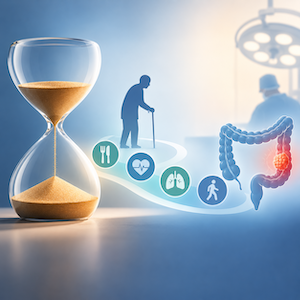
The coexistence of advanced age and frailty represents a potentially explosive combination that is becoming increasingly prevalent across Western countries. Frail older patients face high perioperative risks, complications, and functional decline, thus affecting recovery and outcomes following emergency surgery. We report the case of a 78-year-old frail female (Performance Status - Eastern Cooperative Oncology Group [PS-ECOG] 3, Clinical Frailty Scale [CFS] 4, Charlson Comorbidity Index [CCI] 6) with subocclusive adenocarcinoma of the hepatic flexure to highlight the value of preoperative optimization and elective surgery. Through home nutritional support, prehabilitation, intravenous (IV) iron, and metabolic stabilization, she underwent elective surgery 14 days after initial evaluation. This case demonstrates that a proper preoperative assessment, even within a short optimization window, followed by tailored preoperative strategies can safely enable major elective surgery in frail elderly patients, reduce perioperative risk, and improve outcomes, thus avoiding emergency laparotomy and its potential complications. The integration of geriatric assessment and enhanced recovery principles may serve as a model for the surgical-geriatrics interface in managing complex oncogeriatric cases requiring timely and effective interventions.
Downloads
1. Sung H, Ferlay J, Siegel RL, et al. Global cancer statistics 2020: GLOBOCAN estimates of incidence and mortality worldwide for 36 cancers in 185 countries. CA Cancer J Clin 2021;71:209-49. DOI: https://doi.org/10.3322/caac.21660
2. Vacante M, Cristaldi E, Basile F, et al. Surgical approach and geriatric evaluation for elderly patients with colorectal cancer. Updates Surg 2019;71:411-7. DOI: https://doi.org/10.1007/s13304-019-00650-3
3. Ugolini G, Pasini F, Ghignone F, et al. How to select elderly colorectal cancer patients for surgery: a pilot study in an Italian academic medical center. Cancer Biol Med 2015;12:302-7.
4. George EL, Hall DE, Youk A, et al. Association between patient frailty and postoperative mortality across multiple noncardiac surgical specialties. JAMA Surg 2021;156:e205152. DOI: https://doi.org/10.1001/jamasurg.2020.5152
5. Mohd Suan MA, Tan WL, Soelar SA, et al. Intestinal obstruction: predictor of poor prognosis in colorectal carcinoma? Epidemiol Health 2015;37:e2015017. DOI: https://doi.org/10.4178/epih/e2015017
6. Ng O, Watts E, Bull CA, et al. Colorectal cancer outcomes in patients aged over 85 years. Ann R Coll Surg Engl 2016;98: 216-21. DOI: https://doi.org/10.1308/rcsann.2016.0085
7. Gong S, Qian D, Riazi S, et al. Association between the FRAIL scale and postoperative complications in older surgical patients: A systematic review and meta-analysis. Anesth Analg 2023;136:251-61. DOI: https://doi.org/10.1213/ANE.0000000000006272
8. Welsh TJ, Gordon AL, Gladman JR. Comprehensive geriatric assessment – a guide for the non-specialist. Int J Clin Pract 2014;68:290-3. DOI: https://doi.org/10.1111/ijcp.12313
9. Rockwood K, Stadnyk K, Carver D, et al. A clinimetric evaluation of specialized geriatric care for rural dwelling, frail older people. J Am Geriatr Soc 2000;48:1080-5. DOI: https://doi.org/10.1111/j.1532-5415.2000.tb04783.x
10. Gustafsson UO, Rockall TA, Wexner S, et al. Guidelines for perioperative care in elective colorectal surgery: Enhanced Recovery After Surgery (ERAS) Society recommendations 2025. Surgery 2025;184:109397. DOI: https://doi.org/10.1016/j.surg.2025.109397
11. Ljungqvist O, de Boer HD. Enhanced recovery after surgery and elderly patients. Anesthesiol Clin 2023;41:647-55. DOI: https://doi.org/10.1016/j.anclin.2023.02.010
12. Buccheri G, Ferrigno D, Tamburini M. Karnofsky and ECOG performance status scoring in lung cancer: A prospective, longitudinal study of 536 patients from a single institution. Eur J Cancer 1996;32:1135-41. DOI: https://doi.org/10.1016/0959-8049(95)00664-8
13. Rockwood K, Theou O. Using the Clinical Frailty Scale in allocating scarce health care resources. Can Geriatr J 2020;23:210-5. DOI: https://doi.org/10.5770/cgj.23.463
14. Charlson ME, Pompei P, Ales KL, MacKenzie CR. A new method of classifying prognostic comorbidity in longitudinal studies: development and validation. J Chronic Dis 1987;40:373-83. DOI: https://doi.org/10.1016/0021-9681(87)90171-8
15. Elia M. Development and use of the ‘Malnutrition Universal Screening Tool’ (‘MUST’) for adults. BAPEN 2023.
16. Amin MB, Greene FL, Edge SB, et al. The Eighth Edition AJCC Cancer Staging Manual: Continuing to build a bridge from a population-based to a more “personalized” approach to cancer staging: The Eighth Edition AJCC Cancer Staging Manual. CA Cancer J Clin 2017;67:93-9. DOI: https://doi.org/10.3322/caac.21388
17. Cavallaro P, Bordeianou L, Bagnall NM, et al. Implementation of an ERAS Pathway in Colorectal Surgery. Clin Colon Rectal Surg 2019;32:102-8. DOI: https://doi.org/10.1055/s-0038-1676474
18. Bagnall NM, Malietzis G, Kennedy RH, et al. A systematic review of enhanced recovery care after colorectal surgery in elderly patients. Colorectal Dis 2014;16:947-56. DOI: https://doi.org/10.1111/codi.12718
19. Slieker J, Frauche P, Jurt J, et al. Enhanced recovery ERAS for elderly: a safe and beneficial pathway in colorectal surgery. Int J Colorectal Dis 2017;32:215-21. DOI: https://doi.org/10.1007/s00384-016-2691-6
CRediT authorship contribution
Alessandro Bergna: conceptualization, design, writing – original draft; Maria Mauri: writing – original draft, critical revision; Vera Rebasti: data collection, writing – original draft; Andrea Rusconi, Ettore Lillo, Leonardo Lenisa, Jacques Megevand: critical revision; Alessandro Bergna, Massimo Amboldi: case management. All authors have read and approved the final version of the manuscript and agreed to be accountable for all aspects of the work.
Data Availability Statement
Data that support the findings of this study are available on request from the corresponding author.
How to Cite

This work is licensed under a Creative Commons Attribution-NonCommercial 4.0 International License.
PAGEPress has chosen to apply the Creative Commons Attribution NonCommercial 4.0 International License (CC BY-NC 4.0) to all manuscripts to be published.


